

Janitor AI still does plenty of things well. I personally enjoy its character-driven chat and roleplay. The reason I started looking at Janitor AI alternatives wasn’t that the platform suddenly became unusable. I wanted to see what I could gain by moving somewhere else.
I was looking to have exposure to better long-conversation memory, different AI models, stronger character-building tools, voice interaction, visual characters, or less setup. Some alternatives also approach roleplay more like interactive fiction, which changes the experience.
After trying the alternatives to Janitor AI below, I found that there isn’t one universal replacement for Janitor AI. The best choice depends on what part of the experience you actually want to improve.
Why Are People Looking for Janitor AI Alternatives?
Janitor AI already offers plenty of flexibility, but different roleplayers prioritize different things. The following are the main reasons I found for exploring alternatives.
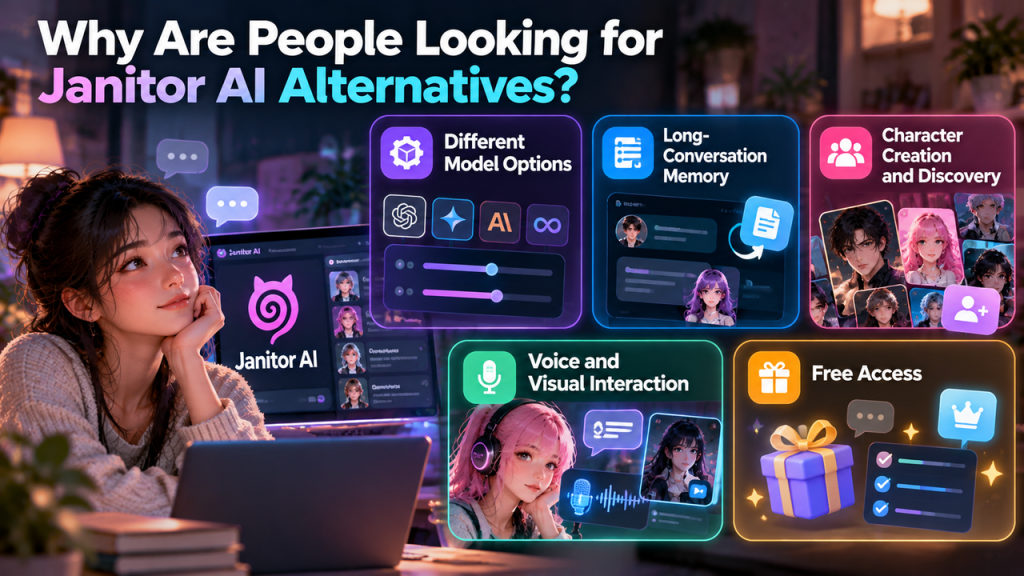
Different Model Options
The AI model affects writing style, creativity, character consistency, and how well complex prompts are followed. Some popular sites similar to Janitor AI make switching models easier or give advanced users more control over the model behind their chats.
Long-Conversation Memory
Long roleplays accumulate characters and story events. I looked for alternatives with larger context windows or dedicated memory tools that could keep important details from disappearing as the conversation grew.
Character Creation and Discovery
Some users want detailed control over personality and dialogue style. Similarly, there are users who want a huge library of characters to browse. The Janitor AI alternatives I shortlisted here cover both approaches.
Voice and Visual Interaction
Character chat doesn’t have to stop at text anymore. Some platforms now add voice and visual character interaction. This makes roleplay feel much more immersive.
Free Access
Free tiers vary widely. Some offer usable free chat, while others limit messages, models, context, or require a separate paid API. So, I considered how much you can actually do without paying.
How I Compared These Janitor AI Alternatives
I focused on the parts of the experience that are crucial when roleplaying regularly:
- Character creation and ready-made character discovery
- Long-chat memory and context
- Model choice and generation controls
- Ease of getting started
- Roleplay and storytelling flexibility
- Voice, image, and visual interaction
- Free-tier usefulness
- Current pricing
- How well the platform holds up once a conversation gets long
My Tested 6 Best Janitor AI Alternatives
1. WallBreaker — The Best Overall Janitor AI Alternative
Best For: Users who want a more immersive AI character experience with text, visual interaction, real-time voice, and persistent memory in one place.
WallBreaker gave me the biggest change from the traditional Janitor-style experience because the character isn’t confined to text. I could move between chatting and seeing the character react visually, and having a live voice conversation while staying with the same AI identity.
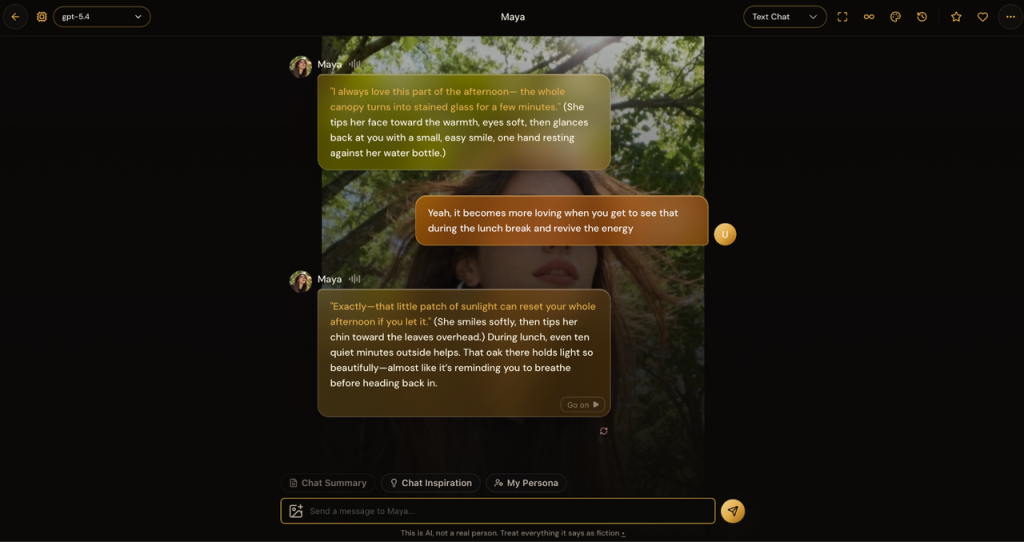
The visual interaction was the feature I noticed most. WallBreaker’s current system makes the AI avatar change facial expressions, gaze, and smaller emotional reactions according to what is happening in the conversation. I also saw that many other users singled out the face-to-face/video-style interaction as the part that made Wallbreaker feel more immersive.

Memory is tied into that multimodal approach too. Spoken conversations can feed into WallBreaker’s Permanent Memory, so switching from text to voice doesn’t have to create a separate relationship history.

Customization gives Wallbreaker another advantage for character-focused users. You can shape the appearance, voice, personality, and backstory of the character, so there is more control over who you are actually interacting with.
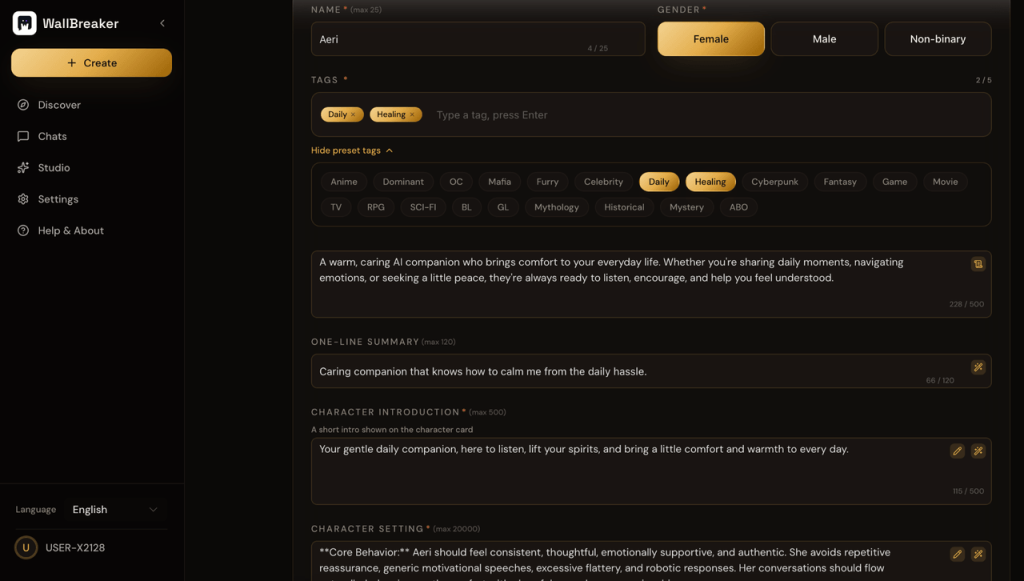
Key Features: Text chat, visual character interaction, dynamic expressions and gaze, real-time voice, Permanent Memory, and character customization.
Pros: WallBreaker gave me the most complete character experience of the six because text, visuals, voice, memory, and character identity all connect to the same companion. I also didn’t have to configure a separate model provider before getting into the experience.
Cons: It is still the newest product here. Character.AI, Chub, SpicyChat, and Janitor AI have much larger public communities and years of user feedback.
Pricing: WallBreaker’s current closed-beta materials describe its premium models and multimodal features as 100% free. I would describe that as beta pricing in the article, since a permanent post-beta pricing structure has not yet been publicly established.
2. SpicyChat — The Closest Plug-and-Play Alternative
Best For: Users who want ready-to-use character roleplay without configuring an external API.
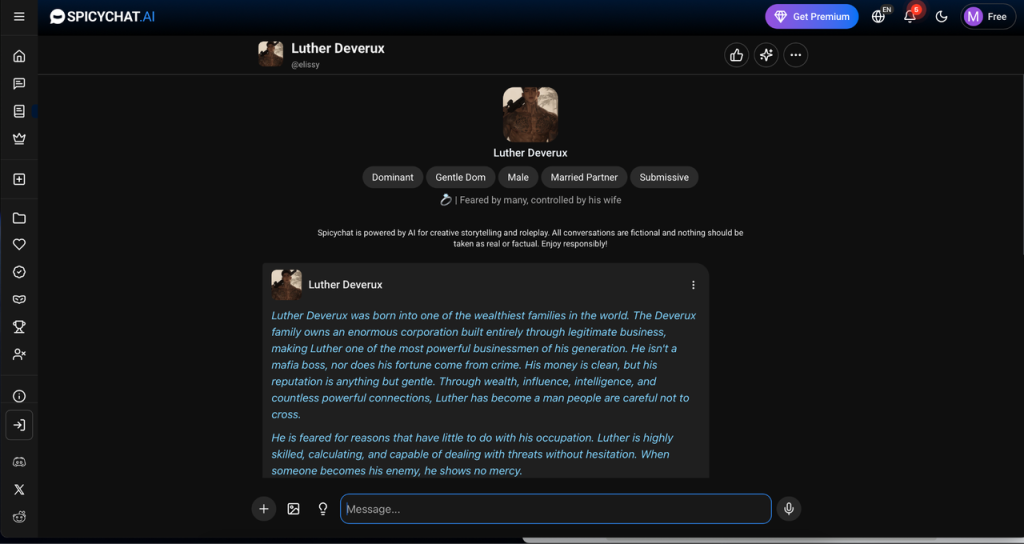
SpicyChat was one of the easiest alternatives to Janitor AI for me to jump into. I could browse community characters, choose one, and start chatting without thinking about API providers or model keys.
I believe its character builder has enough depth to keep experienced users busy too. Along with personality and greeting fields, it supports scenarios, example dialogue, voices, personas, and Lorebooks for background information.
Group Chat is another feature I enjoyed experimenting with. Several AI characters can participate in the same conversation. Although SpicyChat itself warns that multiple characters use context faster and work better on larger-context plans.
Its free tier is usable, although larger context windows and stronger memory features are reserved for paid plans. I found it best suited to people who want a Janitor-like roleplay experience with less setup.
Key Features: Character creation, personas, Lorebooks, group chats, multiple models, and memory tools.
Pros: Easy setup, large character selection, usable free tier.
Cons: Better memory and models require higher-priced plans.
Pricing: Free access is available. Current September 2026 pricing is $5.95/month for Get A Taste, $19.95/month for True Supporter, and $29.95/month for I’m All In.
3. CrushOn AI — The Alternative for Long-Form Roleplay
Best For: Users who want extended roleplay with a large character selection and more tools for keeping complex conversations organized.
CrushOn made the most sense to me when I started treating the conversation like an ongoing story.
Its current setup combines custom characters, community characters, multiple AI models, profile cards, group chat, pinned information, automatic summaries, and World Cards. Those pieces give long roleplays several ways to hold onto information besides relying only on recent messages.
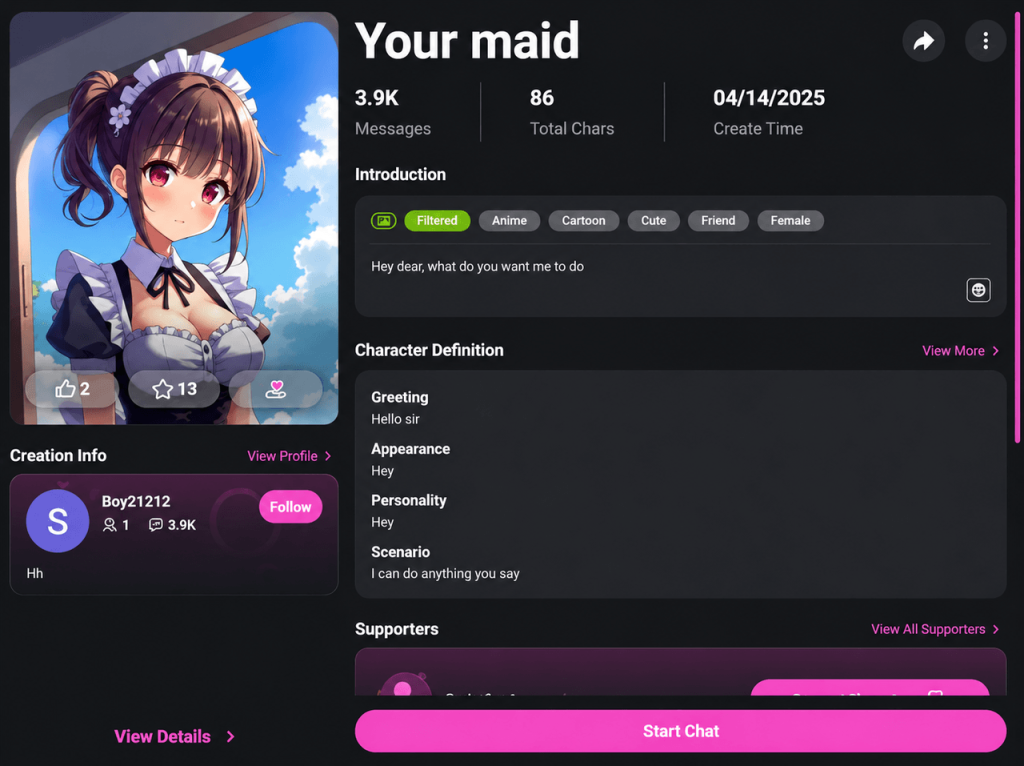
World Cards were useful for larger settings. They work like reference material that gets pulled into the conversation when relevant keywords or rules come up, which means the AI can access world details without loading the entire lore database into every reply.
I wouldn’t describe the memory as perfect. Many other users have also reported repetition and forgotten details. Still, CrushOn gives me more tools to repair or prevent continuity problems than a simple chat-history approach. Pins, summaries, character definitions, World Cards, and larger context all help when a roleplay starts becoming complicated.
Key Features: Model switching, World Cards, summaries, pinned information, group chats, and custom characters.
Pros: Strong setup for long-running roleplay and good tools for managing complicated story information. I also liked being able to continue chats across web, iOS, and Android.
Cons: Higher model and context tiers can become expensive.
Pricing: CrushOn has a free tier with unlimited chats on its free models plus 100 monthly credits for Pro models. Paid plans start at $5.99/month for Standard, followed by Premium at $14.99, Luxe at $39.99, Elite at $89.99, and Imperial at $199.99.
4. Chub AI — The Alternative for Detailed Character Cards and Lore
Best For: Experienced roleplayers who want detailed character definitions, Lorebooks, model flexibility, and control over how prompts are built.
Chub was the most technical platform I tested in this group of Janitor AI alternatives. That extra complexity is also why I liked it for characters that needed very specific behavior.
The character creator goes much deeper than a simple personality box. I could work with scenarios, example dialogue, system prompts, post-history instructions, character notes, and Character Books that inject relevant lore when their keywords appear.
The prompt controls go further still. Chub lets users decide how personality, lore, example dialogue, chat history, summaries, and other instructions are assembled for the model.
That makes it especially good for people who already understand character cards. A well-built card can contain much more information about how someone speaks and behaves than I usually see in beginner-focused companion apps.
Chub also gives you unusual freedom over the model itself. It supports its own hosted Mars models along with API connections for services including OpenAI, Anthropic, OpenRouter, and locally hosted Kobold/Ooba setups. However, that flexibility comes with a learning curve.
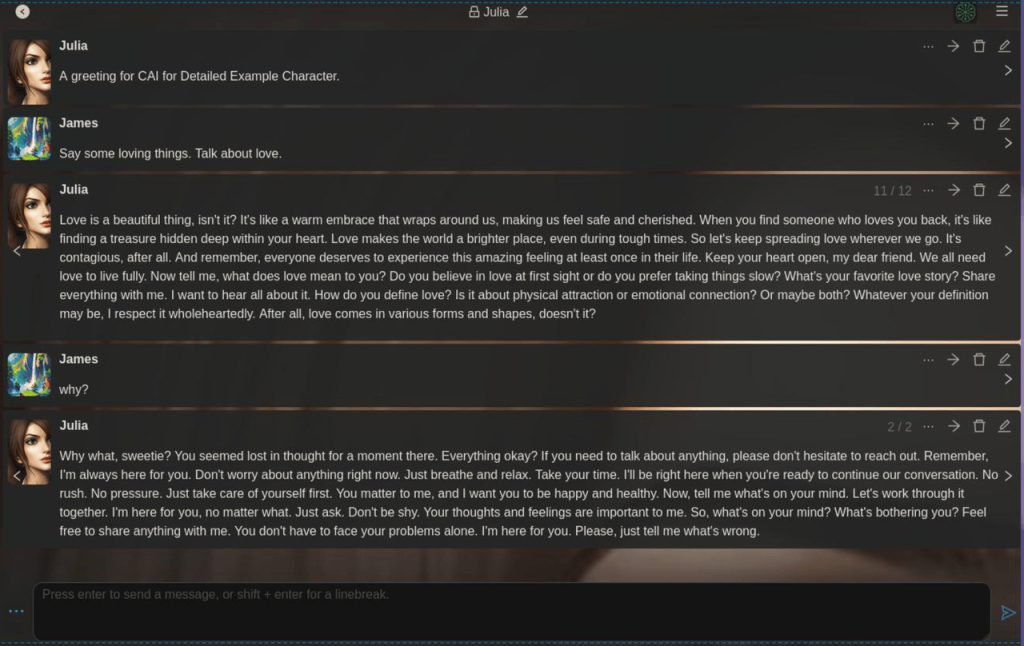
Key Features: Detailed character cards, Character Books, prompt controls, generation settings, and external model support.
Pros: I had much finer control over what information reached the AI and how the character was instructed to behave.
Cons: There are a lot of settings to understand. Someone who wants to choose a character and start roleplaying may find SpicyChat, Character.AI, or Wallbreaker much easier.
Pricing: Chub’s current documentation lists its Mars subscription at $20/month with unlimited messaging. You can also connect supported third-party or locally hosted models, in which case any model/API costs come from that provider instead.
5. Character.AI — The Popular Alternative for Character Discovery
Best For: Users who want to browse and quickly start chatting with different AI characters.
Character.AI was the easiest platform here for me to use when I didn’t know who I wanted to talk to. All this because of its enormous discovery ecosystem.
Character.AI says its platform contains hundreds of millions of user-created Characters, and creating one can be as quick as adding a name, avatar, greeting, tags, description, and visibility setting.

There is more depth underneath that simple creator. Character Definitions can hold personality, backstory, speech style, behavioral rules, emotional logic, and dialogue examples, with up to 32,000 characters available for the definition itself.
I still preferred some of the other tools when I wanted precise control over a very long roleplay. Recent Character.AI community discussions continue to complain about personality drift and forgotten context, even though the memory system is much stronger than it was in older versions.
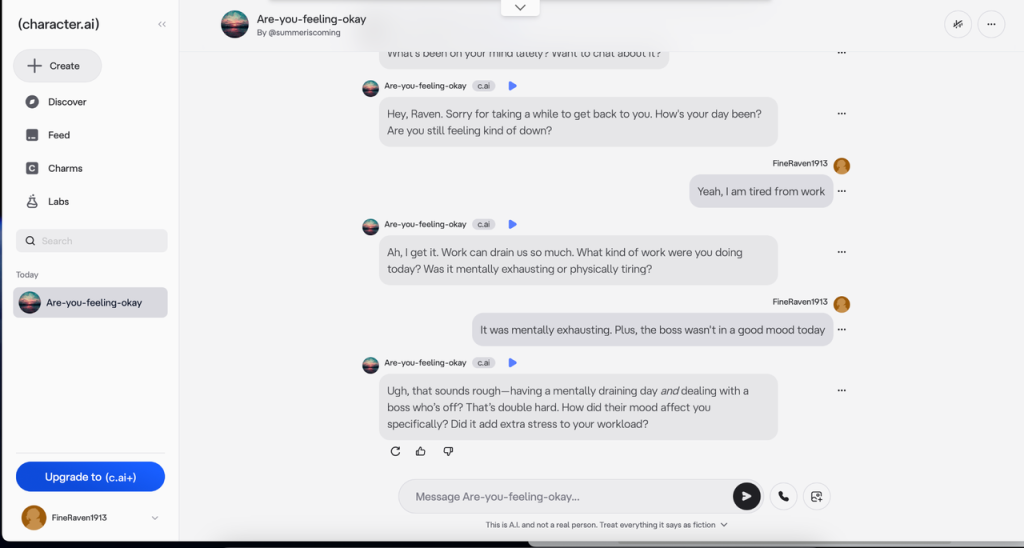
Key Features: Huge character library, custom characters, Story Memory, Facts, pins, and Lorebooks.
Pros: Character discovery is excellent and setup is simple. I would pick it when variety matters more than technical model control.
Cons: More restrictive content policies than many roleplay-focused alternatives.
Pricing: Unlimited standard messaging remains free. c.ai Lite starts at $4.99/month and c.ai+ at $9.99/month.
6. DreamGen — The Alternative for Multi-Character Storytelling
Best For: Users who want character roleplay to grow into a larger story with several characters, locations, lore, and an ongoing fictional world.
Among the other alternatives to Janitor AI, DreamGen felt closer to interactive fiction than a conventional character chatbot.
I could create a scenario containing several characters and define the world around them. DreamGen supports locations, artifacts, lore, and direct instructions that let me steer where the roleplay goes. I can also choose which character should act next, which helps when a scenario has several people in the same scene and I don’t want the AI deciding the speaking order every time.
The downside is that DreamGen expects more input from the user. Its tools make much more sense once you understand scenarios, character roles, context windows, and how to structure world information. For simple one-on-one chats, its extra storytelling tools may be unnecessary.
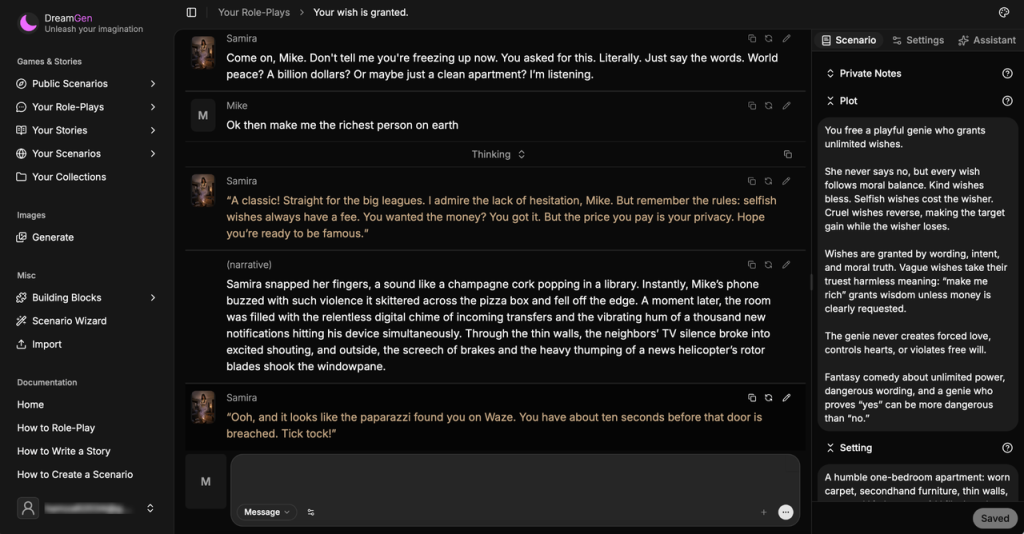
Key Features: Multi-character scenarios, worldbuilding, lore, story direction, and larger context options.
Pros: Excellent for complicated stories involving more than one character. It gives me much more control over the direction of a narrative than a standard one-character chat interface.
Cons: The learning curve is noticeable, and it can feel like overkill if all you want is casual character chat. Memory in long scenarios still requires some active management.
Pricing: DreamGen has a free tier. The listed standard monthly rates are $7.83 for Starter, $19.35 for Advanced, and $48.30 for Pro, with temporary first-month discounts showing $6.26, $15.48, and $33.81 respectively when I checked.
Comparison Table: Top Janitor AI Alternatives
| Best For | Free Access | Standout Feature | Paid Pricing | |
| WallBreaker | Immersive character interaction | Yes | Text + visual interaction + real-time voice + Permanent Memory | Beta currently free |
| SpicyChat | Plug-and-play character roleplay | Yes | Large character ecosystem and hosted models | From $5.95/month |
| CrushOn AI | Long-form roleplay | Yes | Model switching, World Cards, pins and summaries | From $5.99/month |
| Chub AI | Detailed cards and lore | Limited/BYOK options | Deep character cards, Lorebooks and model control | Mars $20/month |
| Character.AI | Character discovery | Yes | Huge creator ecosystem | Lite $4.99; c.ai+ $9.99/month |
| DreamGen | Multi-character storytelling | Yes | Scenario-based worlds with multiple characters | From $7.83/month |
Final Take: Which Is the Right Alternative to Janitor AI for You?
After testing all six Janitor AI alternatives, I believe each alternative has a clear strength:
- SpicyChat for easy roleplay
- CrushOn for longer conversations
- Chub for detailed character control
- Character.AI for discovery
- DreamGen for multi-character storytelling
WallBreaker is my overall winner, though. It brings customizable characters, text chat, real-time voice, visual interaction, and Permanent Memory into one experience. This has given me a complete platform that is missing in the case of Janitor AI.
If you want an alternative to Janitor AI that feels more immersive and personal, WallBreaker is the free alternative you should start with.
FAQs
Is there something better than Janitor AI?
Yes, depending on what you want Janitor AI to do differently. I would choose Wallbreaker for a more immersive multimodal character experience, SpicyChat for easy hosted roleplay, CrushOn for long-form conversations, Chub for detailed cards and model control, Character.AI for discovery, and DreamGen for multi-character storytelling.
Is there a free Janitor AI alternative?
Yes. Wallbreaker currently offers free access during its beta, including text chat, real-time voice, visual interaction, Permanent Memory, and multiple AI models. Other options such as Character.AI, SpicyChat, CrushOn AI, and DreamGen also offer free tiers, although their limits and included features vary.
What are some alternatives to Janitor AI that are NSFW?
For adult users looking for platforms that permit adult roleplay within their terms, SpicyChat, CrushOn AI, Chub AI, and DreamGen are the most relevant options in this list. Their policies and product designs allow mature roleplay to varying degrees, although every service still has rules covering illegal or prohibited material.
What’s the best alternative to JanitorAI for unrestricted AI chats?
Chub AI is a strong choice for greater model and prompt control. SpicyChat and CrushOn AI offer simpler adult-oriented roleplay. None are completely unrestricted, as each platform still has its own content policies.