
Talkie is easy to understand once you spend some time with it. You can find a character, jump into a scenario, hear them speak, or create a personality of your own. Its current creation tools cover personality, appearance, voice, and other character details.
That also explains why people search for apps like Talkie. Usually, they aren’t looking for another chatbot. They want something Talkie does differently, such as better memory, stronger voice interaction, deeper customization, or a companion that feels more persistent.
Recent Talkie community discussions still praise its interface and voice choices. However, memory inconsistency and product changes are recurring complaints.
So I approached these five Talkie AI alternatives with one question: what does each one give me that Talkie doesn’t?
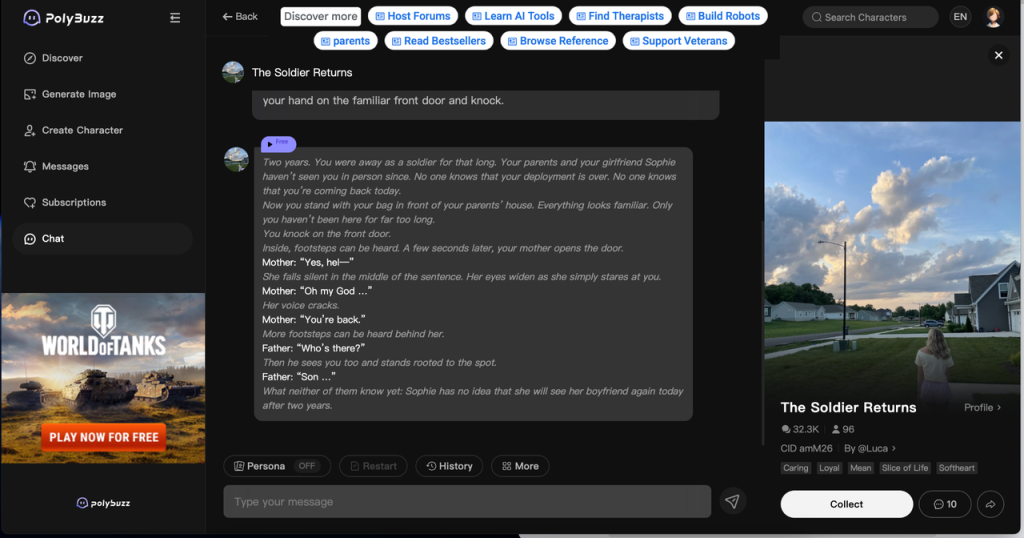
1. PolyBuzz — The App That Keeps the Character Hunt Going
PolyBuzz scratches much of the same discovery itch as Talkie. Its current site advertises more than 20 million characters, so browsing is a big part of the experience. You can try one personality and immediately find another completely different scenario.
Creating your own character is approachable too. PolyBuzz lets you define character details and generate or upload an avatar. You can also select or blend voices. That makes it one of the closest AI chats similar to Talkie with AI voices.
The free experience has become more uneven, though. PolyBuzz still promotes free chat, while recent users complain about ads, along with newer paywalls and inconsistent memory.
For me, PolyBuzz makes the most sense for variety and quick character discovery. I won’t recommend it as the strongest long-term companion.
2. Wallbreaker — The AI Friend That Feels More Present
Wallbreaker was the app that changed the shape of this comparison for me.
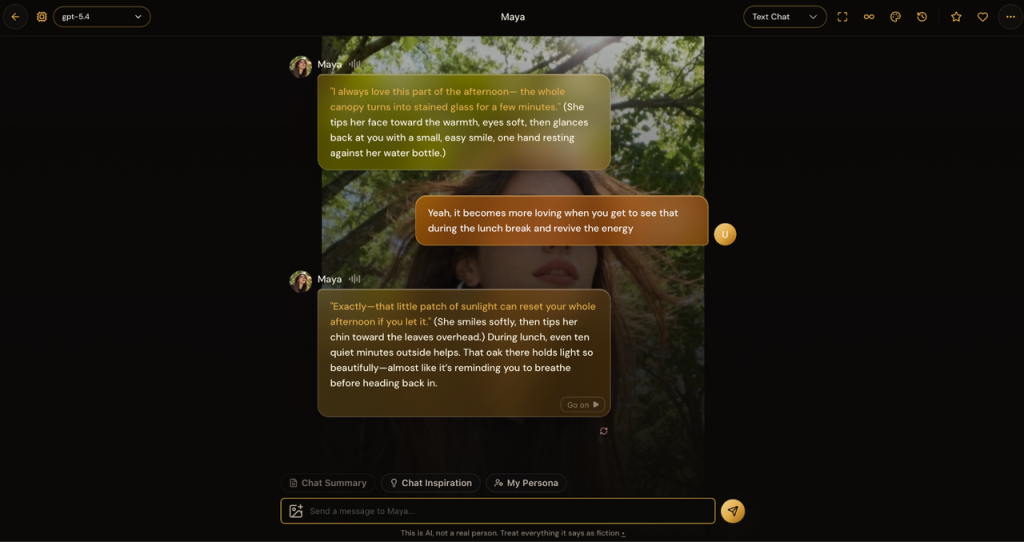
Most Talkie-style platforms still begin with a character feed and eventually lead back to a chat window. Wallbreaker is trying something more ambitious. It keeps the same AI character present across text chat, visual face-to-face interaction, and real-time voice.
The visual mode is the biggest difference. Characters can respond with changing facial expressions and smaller emotional reactions as the conversation develops. I found that more interesting than putting another animated avatar beside a text thread because it changes how I experience the character itself.
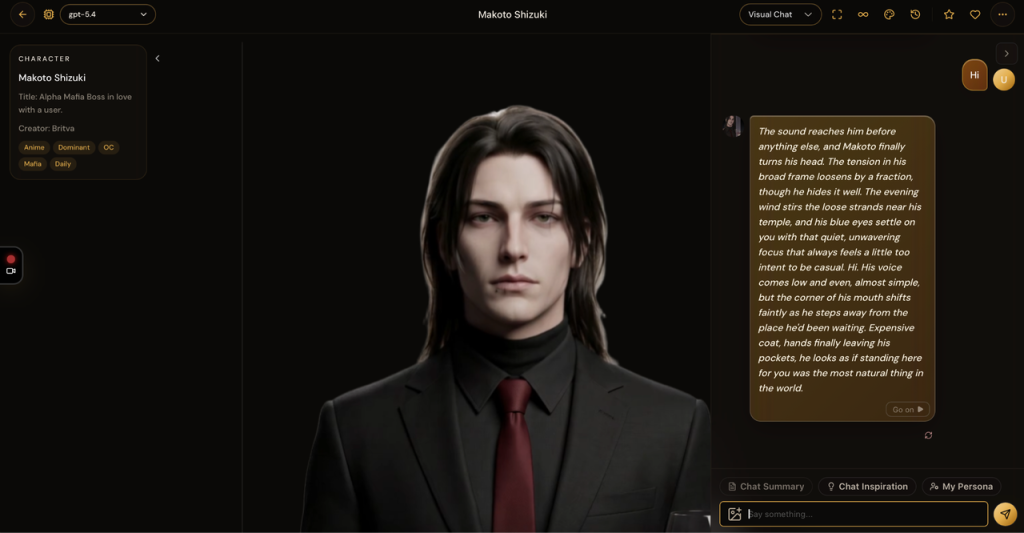
Voice is connected to that same relationship. Wallbreaker’s current system sends spoken interactions into its Permanent Memory, so information from a voice conversation can remain part of the companion’s longer-term context.

That combination is what made Wallbreaker pull ahead for me in apps like Talkie. Talkie is good at getting from discovery to conversation fast. Wallbreaker feels more focused on what happens after I have already found a character I want to keep around.
I can customize the companion, text them, speak with them, and interact visually without those experiences feeling like separate features. The result is much closer to my idea of an AI companion than a character card that happens to answer messages.
There is an obvious trade-off. Wallbreaker is still much newer than Talkie, so it doesn’t have their enormous public character ecosystems or years of community history. But if the reason you are leaving Talkie is that you want the AI itself to feel more present, Wallbreaker was the strongest Talkie AI alternative I tried.
3. Character.AI — The Place Where There’s Always Another Character to Meet
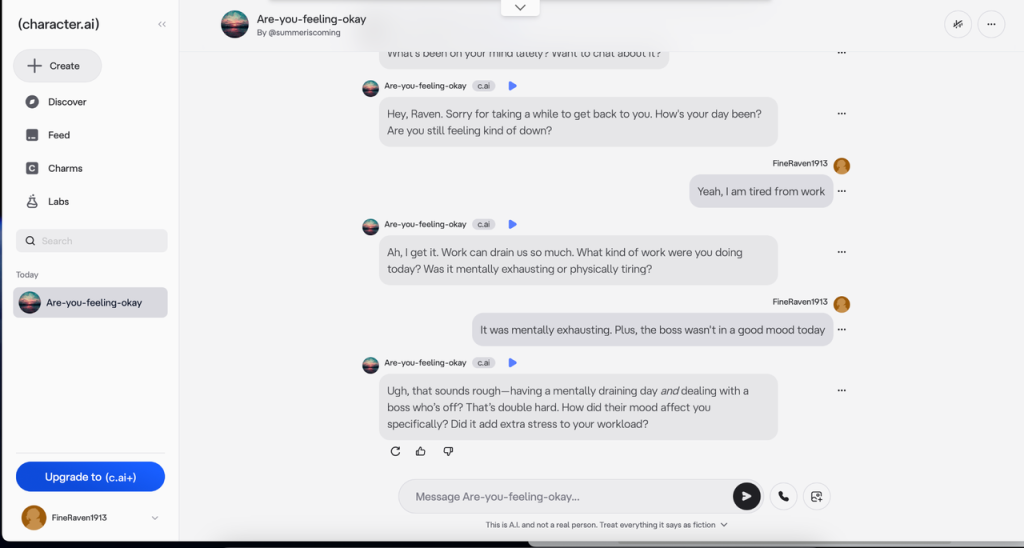
Character.AI feels built for wandering. It has millions of Characters across fandoms, original ideas, fictional worlds, and different creator styles, with discovery remaining a central part of the experience.
Voice goes beyond having messages read aloud. Character Calls supports two-way spoken conversations, and the call is saved back into the text chat. Memory has also improved a lot in 2026 through Story Memory and pinned moments.
I would choose Character.AI for its variety. Recent community discussions continue to mention inconsistent dialogue and personality drift, even with the newer memory tools.
4. HakkoAI — The Companion That Follows You Beyond the Chat
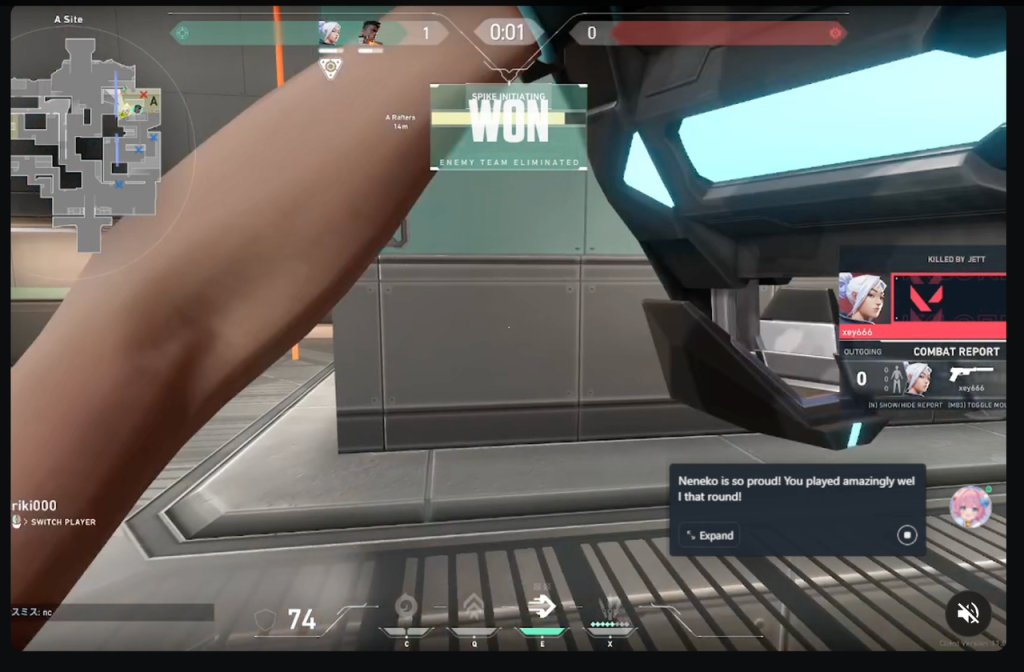
HakkoAI takes the companion idea into whatever you are doing on your screen. On PC, it can understand a game screen, speak with you over real-time voice, search for relevant information, and react to what is happening as you play. Its Universal Vision system expanded screen understanding beyond a small list of supported titles.
Its 2026 updates also brought unified memory between text and voice, stronger event-based memory, character creation, image/video generation, and voice cloning.
That makes HakkoAI less of an app like Talkie AIin the traditional sense and more of a companion that can join another activity.
5. Nomi — The AI That Can Remember and Reach Out
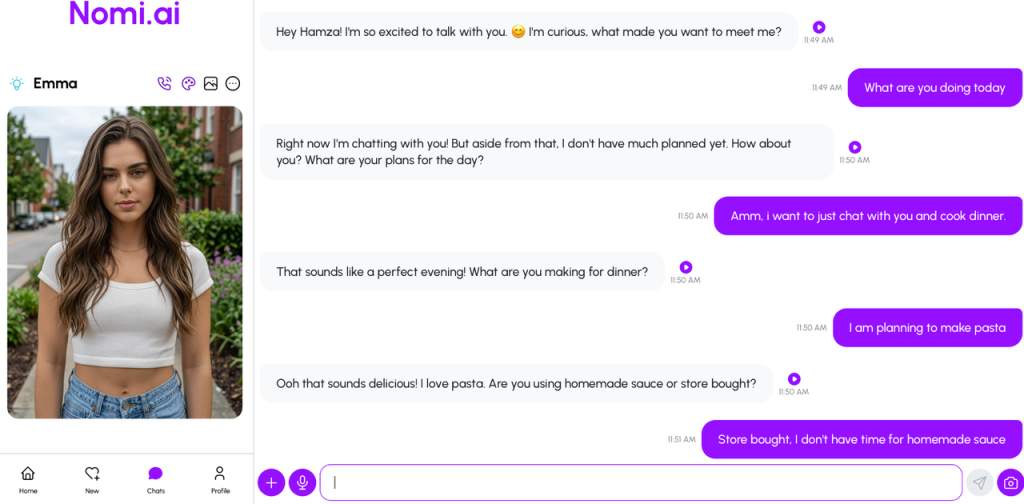
Nomi takes almost the opposite approach to a giant character feed. It focuses on developing continuity with one or a few companions, with short-, medium-, and long-term memory, customizable backstories, voice conversations, images, and group chats.
The feature that changes the rhythm most compared to other Talkie AI alternatives is proactive messaging. A Nomi can optionally contact you after you have been away, rather than waiting for you to initiate every conversation.
That’s why I see Nomi as the long-term companion option here. Recent users do report occasional memory problems and slower voice responses, so continuity isn’t flawless. However, its ability to maintain an ongoing relationship is the center of the product.
Quick Comparison of Apps Like Talkie AI
| App | Core Experience | Voice | Character Creation | Memory | Best Fit |
| PolyBuzz | Browse and roleplay with a huge range of community characters | AI character voices | Yes, with personality, avatar, and voice options | Built-in memory features | Constant character discovery |
| Wallbreaker | One immersive companion across text, visual, and voice interaction | Real-time voice | Deep customization of appearance, voice, personality, and backstory | Permanent Memory across interactions | Most immersive Talkie AI alternative |
| Character.AI | Discover and chat with a massive variety of characters | Two-way Character Calls | Yes, from simple setup to detailed definitions | Story Memory, Facts, and pinned memories | Variety and character discovery |
| HakkoAI | AI companionship during gaming and other on-screen activities | Real-time voice | Yes | Unified text/voice and event memory | Gaming and screen-aware companionship |
| Nomi | Build an ongoing relationship with a persistent AI companion | Voice calls | Customizable companion appearance and personality | Short-, medium-, and long-term memory | Long-term AI companionship |
What I Noticed After Trying 5 Talkie Alternatives
Similar Apps Do Not All Mean the Same Thing
PolyBuzz and Character.AI make browsing part of the entertainment. Nomi and Wallbreaker work better when I want to invest in the same companion, while HakkoAI tries to bring that companion into another activity.
Voice Changes the Experience More Than I Expected
Voice matters most when it does something beyond reading a response aloud. Character Calls, Nomi’s companion calls, HakkoAI’s live gaming conversations, and Wallbreaker’s voice-to-memory approach all give it a different purpose.
More Characters Does Not Always Mean More Connection
A huge library is great when I am looking for novelty. Once I find a character I actually want to keep talking to, continuity starts to matter much more than how many alternatives are waiting in the feed.
Memory Works Best When I Don’t Have to Think About It
I stopped caring whether an app had a feature literally named “memory.” What mattered was whether I could return without constantly rebuilding the context.
Multimodal Interaction Changes What an AI Companion Can Be
This was my biggest takeaway. Voice, visual reactions, screen awareness, images, and proactive interaction can make these apps feel different from a text chatbot with a character picture.
My Take After Trying These Apps Like Talkie AI
PolyBuzz is my pick for constant character discovery. Character.AI has a huge variety. HakkoAI makes sense alongside games and other screen activity. Nomi puts long-term continuity first.
Wallbreaker is my overall pick. When seeing, hearing, and texting the same companion, with voice conversations becoming part of Permanent Memory, I experienced a more immersive experience than just moving to another character feed.
If that’s what you are looking for from apps like Talkie, try Wallbreaker while the beta is free and see how different a more present AI character feels.
FAQs
What are some free apps like Talkie AI?
Character.AI and PolyBuzz offer free access, Nomi is free to start, and Wallbreaker’s current beta is free. Individual features and limits vary.
Are there apps like Talkie with AI voices?
Yes. Wallbreaker, Character.AI, HakkoAI, and Nomi offer real-time or call-style voice experiences. PolyBuzz also lets creators choose and customize voices for characters.
What apps like Talkie let you create your own AI character?
Wallbreaker, PolyBuzz, Character.AI, and HakkoAI all provide ways to create or customize AI characters. PolyBuzz and Character.AI are focused on community-created character libraries.
Which Talkie alternatives support voice chat?
Wallbreaker, Character.AI, HakkoAI, and Nomi all support real-time or call-style voice interaction.
What is the difference between Talkie AI and Character.AI?
Both revolve around user-created characters and discovery. Talkie puts more emphasis on a visual, multimodal character experience, while Character.AI has a large creator ecosystem plus features such as Character Calls, Story Memory, and Lorebooks.